More highlights from the last several installments of the Review of Biblical Literature:
Ismo O. Dunderberg
Beyond Gnosticism: Myth, Lifestyle, and Society in the School of Valentinus
Reviewed by Marvin Meyer
Israel Finkelstein and Amihai Mazar; edited by Brian B. Schmidt
The Quest for the Historical Israel: Debating Archaeology and the History of Early Israel
Reviewed by Ralph K. Hawkins
Richard A. Horsley, ed.
In the Shadow of Empire: Reclaiming the Bible as a History of Faithful Resistance
Reviewed by Roland Boer
Walter C. Kaiser, Darrell L. Bock, and Peter Enns; edited by Kenneth Berding and Jonathan Lunde
Three Views on the New Testament Use of the Old Testament
Reviewed by Stephen Moyise
David Marcus, ed.
Biblia Hebraica Quinta: Ezra and Nehemiah
Reviewed by Andrew Steinmann
Russell Pregeant
Knowing Truth, Doing Good: Engaging New Testament Ethics
Reviewed by M. Eugene Boring
Leo G. Perdue, ed.
Scribes, Sages, and Seers: The Sage in the Eastern Mediterranean World
Reviewed by James L. Crenshaw
Tammi J. Schneider
Mothers of Promise: Women in the Book of Genesis
Reviewed by Ellen White
H. G. M. Williamson, ed.
Understanding the History of Ancient Israel
Reviewed by Walter Dietrich
Robert W. Yarbrough
1, 2, and 3 John
Reviewed by Tobias Nicklas
Noam Adler
A Comprehensive Collection of Oil Lamps of the Holy Land from the Adler Collection
Reviewed by Jodi Magness
Janice Capel Anderson and Stephen D. Moore, eds.
Mark and Method: New Approaches in Biblical Studies
Reviewed by Renate Viveen Hood
Roger S. Bagnall, ed.
Egypt in the Byzantine World 300-700
Reviewed by David Frankfurter
David B. Burrell
Deconstructing Theodicy: Why Job Has Nothing to Say to the Puzzle of Suffering
Reviewed by F. Rachel Magdalene
Warren Carter
John and Empire: Initial Explorations
Reviewed by Stephan Witetschek
Raymond F. Collins
The Power of Images in Paul
Reviewed by Nils Neumann
Craig A. Evans, ed.
Encyclopedia of the Historical Jesus
Reviewed by Christoph Stenschke
Susan Haber; edited by Adele Reinhartz
"They Shall Purify Themselves": Essays on Purity in Early Judaism
Reviewed by Jonathan D. Lawrence
Mika Hietanen
Paul's Argumentation in Galatians: A Pragma-Dialectical Analysis
Reviewed by Johan S. Vos
Jerome Murphy-O'Connor
St. Paul's Ephesus: Texts and Archaeology
Reviewed by Jan Van Der Watt
Marvin Sweeney
Reading the Hebrew Bible after the Shoah: Engaging Holocaust Theology
Reviewed by Jon D. Levenson
Benedict T. Viviano
Matthew and His World: The Gospel of the Open Jewish Christians Studies in Biblical Theology
Reviewed by Boris Repschinski
John Ashton
Understanding the Fourth Gospel
Reviewed by Craig R. Koester
Reimund Bieringer, Emmanuel Nathan, and Dominika Kurek-Chomycz
2 Corinthians: A Bibliography
Reviewed by Victor Paul Furnish
Michael F. Bird
Jesus and the Origins of the Gentile Mission
Reviewed by Andreas J. Kostenberger
Dirk J. Human, ed.
Psalms and Mythology
Reviewed by Jeffery M. Leonard
Patricia A. Kirkpatrick and Timothy Goltz, eds.
The Function of Ancient Historiography in Biblical and Cognate Studies
Reviewed by Ernst Axel Knauf
Ilana Pardes
Melville's Bibles
Reviewed by Michael Kaler
Stanley E. Porter, ed.
Dictionary of Biblical Criticism and Interpretation
Reviewed by Christoph Stenschke
Tuesday, June 16, 2009


RBL Highlights: 6/16/09 (Part I)
Highlights from the last several installments of the Review of Biblical Literature:
Roger David Aus
The Death, Burial, and Resurrection of Jesus and the Death, Burial, and Translation of Moses in Judaic Tradition
Reviewed by James Crossley
Mark G. Brett
Decolonizing God: The Bible in the Tides of Empire
Reviewed by Roland Boer
Gene L. Green
Jude and 2 Peter
Reviewed by Peter H. Davids
Michael P. Knowles
We Preach Not Ourselves: Paul on Proclamation
Reviewed by H. H. Drake Williams III
Jerome H. Neyrey and Eric C. Stewart, eds.
The Social World of the New Testament: Insights and Models
Reviewed by Heather McKay
Leo G. Perdue
The Sword and the Stylus: An Introduction to Wisdom in the Age of Empires
Reviewed by Benjamin G. Wright III
Stanley E. Porter and Christopher D. Stanley, eds.
As It Is Written: Studying Paul's Use of Scripture
Reviewed by Rodrigo J. Morales
Tom Thatcher and Stephen D. Moore, eds.
Anatomies of Narrative Criticism: The Past, Present, and Futures of the Fourth Gospel as Literature
Reviewed by Steven Hunt
Joshua A. Berman
Created Equal: How the Bible Broke with Ancient Political Thought
Reviewed by Mark Leuchter
Constantine R. Campbell
Basics of Verbal Aspect in Biblical Greek
Reviewed by C. Michael Robbins
Sang Youl Cho
Lesser Deities in the Ugaritic Texts and the Hebrew Bible: A Comparative Study of Their Nature and Roles
Reviewed by Lena-Sofia Tiemeyer
A.-F. Christidis, ed.
A History of Ancient Greek: From the Beginnings to Late Antiquity
Reviewed by Douglas Estes
Lowell K. Handy
Jonah's World: Social Science and the Reading of Prophetic Story
Reviewed by Karl Moller
Richard A. Horsley
Jesus in Context: Power, People, and Performance
Reviewed by Stephan Witetschek
Peter Jeffery
The Secret Gospel of Mark Unveiled: Imagined Rituals of Sex, Death, and Madness in a Biblical Forgery
Reviewed by J. Harold Ellens
Edward W. Klink III
The Sheep of the Fold: The Audience and Origin of the Gospel of John
Reviewed by Cornelis Bennema
Katherine M. Stott
Why Did They Write This Way? Reflections on References to Written Documents in the Hebrew Bible and Ancient Literature
Reviewed by Werner H. Kelber
David Shepherd, ed.
Images of the Word: Hollywood's Bible and Beyond
Reviewed by Christopher Fuller
A. Philip Brown II and Bryan W. Smith, eds.
A Reader's Hebrew Bible
Reviewed by Hallvard Hagelia
Jason König and Tim Whitmarsh, eds.
Ordering Knowledge in the Roman Empire
Reviewed by Stephan Witetschek
Diana Lipton
Longing for Egypt and Other Unexpected Biblical Tales
Reviewed by Amelia Devin Freedman
Antti Laato and Jacques van Ruiten, eds.
Rewritten Bible Reconsidered: Proceedings of the Conference in Karkku, Finland
Reviewed by Sidnie White Crawford
Bryan M. Litfin
Getting to Know the Church Fathers: An Evangelical Introduction
Reviewed by H. H. Drake Williams III
Scot McKnight and Joseph B. Modica, eds.
Who Do My Opponents Say That I Am? An Investigation of the Accusations against Jesus
Reviewed by V. George Shillington
Chaim Navon
Genesis and Jewish Thought
Reviewed by David M. Maas
V. Henry T. Nguyen
Christian Identity in Corinth: A Comparative Study of 2 Corinthians, Epictetus and Valerius Maximus
Reviewed by Thomas Schmeller
I'm Baaack!
After an extended hiatus to wrap up my first semester of doctoral work, I'm excited to be back among the ranks of active bibliobloggers. So put me back on the blogroll, Nick Norelli... I've got a lot of catching up to do. ;-)
Wednesday, April 29, 2009
RBL Highlights: 4/30/09
Alright, after this one I'm really taking a break... promise. ;-)
William S. Campbell, Peter S. Hawkins, and Brenda Deen Schildgen, eds.
Medieval Readings of Romans
Reviewed by Francis Dalrymple-Hamilton
Adrian Curtis
Oxford Bible Atlas
Reviewed by George Athas
Lois M. Farag
St. Cyril of Alexandria, a New Testament Exegete: His Commentary on the Gospel of John
Reviewed by Hennie Stander
Terence E. Fretheim
Abraham: Trials of Family and Faith
Reviewed by Hallvard Hagelia
Susan Haber; edited by Adele Reinhartz
"They Shall Purify Themselves": Essays on Purity in Early Judaism
Reviewed by Joshua Schwartz
Justin K. Hardin
Galatians and the Imperial Cult: A Critical Analysis of the First-Century Social Context of Paul's Letter
Reviewed by Mark D. Nanos
Susan R. Holman, ed.
Wealth and Poverty in Early Church and Society
Reviewed by Preston M. Sprinkle
Henry Ansgar Kelly
Satan: A Biography
Reviewed by James A. Metzger
Dale B. Martin
Pedagogy of the Bible: An Analysis and Proposal
Reviewed by Renate Viveen Hood
Kenneth Schenck
Cosmology and Eschatology in Hebrews: The Settings of the Sacrifice
Reviewed by Jason A. Whitlark
F. Scott Spencer
The Gospel of Luke and Acts of the Apostles
Reviewed by Gregory E. Sterling
Hilarious!
Alright... I know that I just announced a brief hiatus from blogging, but this comic (courtesy of one of my students; thanks, Lindsey!) was too funny to ignore:
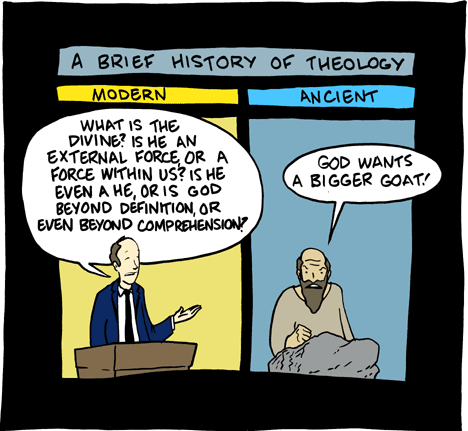
"I shall return."
The now-familiar words of Gen. Douglas MacArthur, which he uttered as he evacuated the Philippine Islands in March 1942 in the wake of a Japanese invasion, only to fulfill his vow three years later...
And I'm sure that if Gen. MacArthur were alive today, and were a biblioblogger, and were inundated with all of the work and other craziness surrounding the finals period, he would repeat the exact same phrase, promising to resume his blogging duties as soon as the semester came to an end.
So, while I'm taking a temporary hiatus from blogging over the next few days as I finish everything up, don't forget about me... because I shall return (and it definitely won't take three years)!
Thursday, April 23, 2009
New Testament Notes: Week 14 (Wednesday)
Some brief notes on the development of early Christian eschatological expectations:
RELC 122 Notes: 4/23
Tuesday, April 21, 2009
Coming to UVA: John M. Perkins
This just in:
Activist, pastor and bestselling author John M. Perkins,
founder of the Voice of Calvary Ministries, will present two lectures at the
University of Virginia.
Perkins will engage in a conversation with U.Va. religious studies professor
Charles Marsh, director of the Project on Lived Theology, on Wednesday,
April 22 at 7 p.m. in the McLeod Hall auditorium.
On Thursday, April 23, from 9 a.m. to noon, Perkins will give a seminar,
"American Evangelicalism and the Practices of Peace," at St. Paul's
Episcopal Church's parish hall, 1700 University Ave.
Perkins is a sharecropper's son who grew up in New Hebron, Miss. amidst dire
poverty. Fleeing to California at age 17 after his older brother's murder at
the hands of a small-town marshal, he vowed never to return to the South.
But after a religious experience in 1960, Perkins returned to Mendenhall,
Miss. to develop a ministry in poor rural communities. While in Mississippi,
his support and leadership in civil rights demonstrations resulted in
repeated harassment, beatings and imprisonment.
Perkins is the author of "A Quiet Revolution: Restoring At-Risk Communities"
and "Let Justice Roll Down," a memoir of his childhood in the segregated
South and his call to racial reconciliation and community building.
Perkins has been a regular speaker at the annual Urbana Youth Leadership
Conferences, and he has served on the boards of Bread for the World, the
National Black Evangelical Association and Koinonia Partners in Americus,
Ga. His writings on faith, racial reconciliation and poverty have appeared
in Sojourners, Christianity Today and Urban Family. In 1989, Perkins founded
the Christian Community Development Association, the organizational
infrastructure of the faith-based community-building movement, which now
includes 8,000 individual members, 500 member organizations and sites in
more than 100 cities.
These lectures are part of the 2009 Spring Institute on Lived Theology:
American Evangelicalism and the Practices of Peace: The Lived Theology of
John M. Perkins, which is sponsored by the Project on Lived Theology.
For information on the Project on Lived Theology, visit
www.livedtheology.org. For information, call 434-924-6743 or e-mail
livedtheology@virginia.edu.
Media Contact
Dan Heuchert
Media Relations
(434) 924-6857
danh@virginia.edu
Monday, April 20, 2009
Vigen Guroian on NPR
UVA's own Vigen Guroian recently appeared on NPR's Speaking of Faith. Check it out here.
Thursday, April 16, 2009
Summer Project: Eusebius of Caesarea's Ecclesiastical History
This week I splurged a bit, and allocated a portion of my forthcoming tax refund to a book purchase: Loeb Classical Library's two-volume edition of Eusebius of Caesarea's Ecclesiastical History. While I've had these on my wish list for some time, I was especially inspired by a recent conversation with Prof. Harry Gamble--who noted that few courses, even at the graduate level, systematically examine the work in its entirety. I'm planning to read through it this summer. Anyone want to join me? ;-)


New Testament Notes: Week 13 (Wednesday)
An introduction to the Catholic Epistles: the Letter to the Hebrews, and the First Letter of Peter:
RELC 122 Notes: 4/16
RBL Highlights: 4/16/09
Highlights from the most recent Review of Biblical Literature:
H. Ausloos, F. García Martínez, M. Vervenne, J. Cook, and B. Lemmelijn, eds.
Translating a Translation: The LXX and Its Modern Translations in the Context of Early Judaism
Reviewed by Tuukka Kauhanen
Lytta Basset
Holy Anger: Jacob, Job, Jesus
Reviewed by Jutta Jokiranta
Elizabeth V. Dowling
Taking Away the Pound: Women, Theology and the Parable of the Pounds in the Gospel of Luke
Reviewed by James A. Metzger
Kathy Ehrensperger
Paul and the Dynamics of Power: Communication and Interaction in the Early Christ-Movement
Reviewed by Thomas R. Blanton IV
Tamara Cohn Eskenazi and Andrea L. Weiss, eds.
The Torah: A Women's Commentary
Reviewed by Susanne Scholz
J. Cheryl Exum and Ela Nutu, eds.
Between the Text and the Canvas: The Bible and Art in Dialogue
Reviewed by Hennie Stander
Harry Alan Hahne
The Corruption and Redemption of Creation: Nature in Romans 8.19-22 and Jewish Apocalyptic Literature
Reviewed by Ron Fay
George Heyman
The Power of Sacrifice: Roman and Christian Discources in Conflict
Reviewed by Giovanni Battista Bazzana
Heidi J. Hornik and Mikeal C. Parsons
Illuminating Luke: Volume 3: The Passion and Resurrection Narratives in Italian Renaissance and Baroque Painting
Reviewed by Hennie Stander
Elizabeth A. McCabe
An Examination of the Isis Cult with Preliminary Exploration into New Testament Studies
Reviewed by John S. Kloppenborg
Kathryn McClymond
Beyond Sacred Violence: A Comparative Study of Sacrifice
Reviewed by Leigh Trevaskis
Saul M. Olyan
Disability in the Hebrew Bible: Interpreting Mental and Physical Differences
Reviewed by David M. Maas
Reviewed by Hector Avalos
Karel van der Toorn
Scribal Culture and the Making of the Hebrew Bible
Reviewed by Frank Polak
New From Baker/WJK: Hebrew Bible
Via Dove. Among these titles is a study of the prophets' relevance for the modern world by a former professor of mine, Carolyn Sharp. I can think of no one more qualified to write such a book.
Evans, Craig A, Emanuel Tov (eds)
Exploring the Origins of the Bible: Canon Formation in Historical, Literary, and Theological Perspective
(Baker Book House, 2008)
Paperback List: $22.99 Dove Price: $18.99
Save $4.00 (17%)
Hess, Richard S
Israelite Religions: An Archaeological and Biblical Survey
(Baker Book House, 2007)
Hardcover List: $34.99 Dove Price: $27.99
Save $7.00 (20%)
Matthews, Victor H
Studying the Ancient Israelites: A Guide to Sources and Methods
(Baker Book House, 2007)
Paperback List: $24.99 Dove Price: $19.99
Save $5.00 (20%)
Seitz, Christopher R
Prophecy and Hermeneutics: Toward a New Introduction to the Prophets
(Baker Book House, 2007)
Paperback List: $22.99 Dove Price: $18.99
Save $4.00 (17%)
Sparks, Kenton L
God's Word in Human Words: An Evangelical Appropriation of Critical Biblical Scholarship
(Baker Book House, 2008)
Paperback List: $26.99 Dove Price: $21.50
Save $5.49 (20%)
Niditch, Susan
Judges: A Commentary
(Westminster John Knox, 2008)
Hardcover List: $49.95 Dove Price: $39.99
Save $9.96 (20%)
Put hardcover in your Shopping Cart
Davies, Philip R
Memories of Ancient Israel: An Introduction to Biblical History-Ancient and Modern
(Westminster John Knox, 2008)
Paperback List: $24.95 Dove Price: $19.99
Save $4.96 (20%)
Sawyer, John F A
Concise Dictionary of the Bible and Its Reception
(Westminster John Knox, 2009)
Paperback List: $29.95 Dove Price: $23.99
Save $5.96 (20%)
Sharp, Carolyn J
Old Testament Prophets for Today
(Westminster John Knox, 2009)
Paperback List: $14.95 Dove Price: $12.99
Save $1.96 (13%)
Tuesday, April 14, 2009
April SBL Forum
News and notes from the SBL, including the publication of an article by my former Hebrew teacher, Ryan Stokes! Congrats!
SBL E-Newsletter
April 14, 2009
Call for Papers
The Paul J. Achtemeier Award for New Testament Scholarship is open for submissions or nominations until 1 July 2009.
JBL 128.1 Spring 2009 has been posted:
Religion and the Bible
Jonathan Z. Smith
Whatever Happened in the Valley of Shinar? A Response to Theodore Hiebert
André Lacocque
Ideology and Social Context of the Deuteronomic Women's Sex Laws (Deuteronomy 22:13-29)
Cynthia Edenburg
Samson's Last Laugh: S/ŠHQ The Pun in Judges 16:25-27
Charles Halton
Topographical Considerations and Redaction Criticism in 2 Kings 3
Erasmus Gass
Why 2 Kings 17 Does Not Constitute a Chapter of Reflection in the "Deuteronomistic History"
Hartmut H. Rösel
The Devil Made David Do It … Or Did He? The Nature, Identity, and Literary Origins of the Satan in 1 Chronicles 21:1
Ryan E. Stokes
"She Binds Her Arms": Rereading Proverbs 31:17
Tzvi Novick
Accession Days and Holidays: The Origins of the Jewish Festival of Purim
Jona Schellekens
Rachel's Tomb
Benjamin D. Cox and Susan Ackerman
April SBL Forum has been posted:
FEATURE
The Perils of Prepublication in the Digital Age: Essenes, Latrines, and the Dead Sea Scrolls
Ian Werrett
IN THE CLASSROOM
Biblical Studies in the Context of the Emerging Religion Major
Jane S. Webster
IN POPULAR CULTURE
Evil in Contemporary American Film: Deep Darkness and Eschatological Hope
Greg Garrett
The Apocalypse of John and Its Mediators, or Why Johnny Cash Wrote a Better Apocalypse than John of Patmos!
William John Lyons
Inventory Reduction Sale through April 30
Almost 300 Society of Biblical Literature and Brown Judaic Studies titles at $7 each are included in the current SBL Inventory Reduction Sale, now through April 30. Click here to browse or download an order form and list of titles.
SBL Spring Sale
Almost all new, recent, and backlisted titles are available to SBL members at a forty percent discount during the spring sale. Download the order form, then mail, fax, or phone your order by June 15. If you prefer to order at the SBL Store, make sure to use the promo code SPG2009 at checkout to receive your discount.
NEW—Special rates for RBL subscriptions:
Individuals and institutions qualifying for SBL online books are also eligible for discount subscription rates to the Review of Biblical Literature. Click on this link to access the forms.
Monday, April 13, 2009
An Interruption of Ben's Interruption of Bart (Try Saying That Five Times Fast)
Over the weekend, I came across the second portion of Ben Witherington's ongoing review and critique of Bart Ehrman's Jesus, Interrupted. I'm looking forward to reading his responses in their entirety; he provides a number of clarifications and rejoinders, and has clearly engaged the book in a thoughtful way. I was particularly struck by a few comments:
I suspect that an overwhelming majority of historians, particularly those who operate beyond the pale of religious studies, would view the first of these dangers with utter incredulity. Supernatural elements such as miraculous events or the actions of the divine exist beyond the capabilities of reasoned, scientific inquiry and are therefore not detectable or demonstrable according to most definitions of critical scholarship. The writings of the New Testament themselves do not constitute "significant evidence to the contrary" on this point, as their critically accessible strata reveal the convictions and assumptions of their authors and recipients. (I have not been convinced by arguments such as those of Richard Bauckham that the gospels should be classified according to a more reliable genre of written materials and therefore regarded as intrinsically superior to other ancient documents with similar contents or features.) As Bultmann and so many others have rightly argued, historical research reveals the relative certainty of the nascent Christian community concerning events such as the resurrection of Jesus, but it is incapable of verifying the event itself without radically redefining the nature and practice of the discipline. Simply put, we cannot conclusively demonstrate, by means of the prevalent historiographical approaches which have evolved since the Enlightenment, that the resurrection occurred; we can only demonstrate that early Christians were certain that it had. To adapt John Meier's useful terminology, this is the point where the historical and the metahistorical come together--where research ends and faith begins.
I think this is an interesting bit of exegesis, and I'm not especially inclined to disagree with it (at least, not without doing some additional reading on my own!). However, I'm curious how Paul's reference to the designation of Christ as "Son of God with power according to the spirit of holiness by resurrection from the dead (Rom. 1:1; italics added) might affect this conclusion. If Paul has some notion of virginal conception, why not reference it here?
Again, I suppose this depends upon the definitions of the terms "historical evidence" and "apostolic." The various writings of the New Testament were all eventually associated with apostolic or immediately sub-apostolic authors and traditions. Some of these were widely accepted; others were not. Eusebius of Caesarea reports that many ancient commentators considered James to be spurious, a judgment shared by many contemporary scholars. I assume that Ben's reference to Apollos amongst this list presumes that he is the author of Hebrews, a supposition for which no firm evidence exists (a number of possibilities have been proposed throughout the centuries; one recollects Origen's famous conclusion that regarding the letter's actual author, "Only God knows"). If the author of the Book of Revelation is writing at the end of the first century (as many scholars assume) and is an otherwise unknown prophetic figure (as many exegetes, both ancient and modern, have suggested), is it appropriate to identify him and his work as "apostolic"? Similarly, what of 2 Peter, which is often dated to the second century? If one accepts the traditional attributions of the later church, then the New Testament corpus can indeed be definitively linked to a handful of key figures from the inception of the movement. Many scholars, however, have not seen sufficient internal and external evidence to do so.
Check out all of Ben's musings in their entirety... they're extremely stimulating! I'm hoping to get back to them at some point.
There are then three dangers we learn of when reading and critically analyzing Gibbon’s classic work [The Decline and Fall of the Roman Empire]: 1) history writing that either dismisses or is dismissive of the role of God in human history, claiming that that is not a part of the historian’s task, even if there is considerable evidence to the contrary, and 2) because of its skeptical bent, history writing that is prone to revisionism of a sort that distorts rather than dissects and correctly analyzes what happened back then and back there; 3) history writing that conveys 1) and 2) in a clear and eloquent and understandable fashion such that the clarity of the explanation makes it appear that the conclusions are obvious and should go without challenge. This of course is the power of good rhetoric—it persuades without necessarily providing the detailed evidence and analysis necessary to prove one’s point.
I suspect that an overwhelming majority of historians, particularly those who operate beyond the pale of religious studies, would view the first of these dangers with utter incredulity. Supernatural elements such as miraculous events or the actions of the divine exist beyond the capabilities of reasoned, scientific inquiry and are therefore not detectable or demonstrable according to most definitions of critical scholarship. The writings of the New Testament themselves do not constitute "significant evidence to the contrary" on this point, as their critically accessible strata reveal the convictions and assumptions of their authors and recipients. (I have not been convinced by arguments such as those of Richard Bauckham that the gospels should be classified according to a more reliable genre of written materials and therefore regarded as intrinsically superior to other ancient documents with similar contents or features.) As Bultmann and so many others have rightly argued, historical research reveals the relative certainty of the nascent Christian community concerning events such as the resurrection of Jesus, but it is incapable of verifying the event itself without radically redefining the nature and practice of the discipline. Simply put, we cannot conclusively demonstrate, by means of the prevalent historiographical approaches which have evolved since the Enlightenment, that the resurrection occurred; we can only demonstrate that early Christians were certain that it had. To adapt John Meier's useful terminology, this is the point where the historical and the metahistorical come together--where research ends and faith begins.
It is of course true that Paul does not directly mention ‘the virginal conception’, but what he says is not only compatible with the idea (see Gal 4.4—God sent his son, born of woman, born under the law. Notice Paul does not say, born of a good Jewish man with proper paternity), Rom. 8.3 suggest knows of the virginal conception idea for he says that God sent his son “in the likeness of sinful flesh”. Now what is the point of the word ‘likeness’ in this verse? I would suggest Paul is saying that Jesus really had flesh but it was not tainted with human fallenness the way all other human flesh was (see Rom. 5.12-21). In other words, Paul already knows about the idea of Jesus being conceived in a pure and sinless manner. The attempt to treat the NT writers as if they were ignorant or ignored or were polemicizing against one another or lived in splendid isolation from one another does not work.
I think this is an interesting bit of exegesis, and I'm not especially inclined to disagree with it (at least, not without doing some additional reading on my own!). However, I'm curious how Paul's reference to the designation of Christ as "Son of God with power according to the spirit of holiness by resurrection from the dead (Rom. 1:1; italics added) might affect this conclusion. If Paul has some notion of virginal conception, why not reference it here?
In fact all of the NT documents can be traced back to apostolic sources or were written by apostles—all of them can be traced to about 9-10 persons who were eyewitnesses or apostles or both. These persons include the Beloved Disciple, Mark, Luke, John of Patmos, Paul, probably Apollos, Peter, James and Jude. 2 Peter is a later composite document made up of material from Peter, Jude, and with a knowledge of the Pauline corpus, but you will notice it does not appear to draw on non-apostolic source material. The claims that we do not know who wrote these books, or that some of them are forged are greatly exaggerated claims, that many historians like myself do not find convincing or compelling on the basis of the actual historical evidence itself.
Again, I suppose this depends upon the definitions of the terms "historical evidence" and "apostolic." The various writings of the New Testament were all eventually associated with apostolic or immediately sub-apostolic authors and traditions. Some of these were widely accepted; others were not. Eusebius of Caesarea reports that many ancient commentators considered James to be spurious, a judgment shared by many contemporary scholars. I assume that Ben's reference to Apollos amongst this list presumes that he is the author of Hebrews, a supposition for which no firm evidence exists (a number of possibilities have been proposed throughout the centuries; one recollects Origen's famous conclusion that regarding the letter's actual author, "Only God knows"). If the author of the Book of Revelation is writing at the end of the first century (as many scholars assume) and is an otherwise unknown prophetic figure (as many exegetes, both ancient and modern, have suggested), is it appropriate to identify him and his work as "apostolic"? Similarly, what of 2 Peter, which is often dated to the second century? If one accepts the traditional attributions of the later church, then the New Testament corpus can indeed be definitively linked to a handful of key figures from the inception of the movement. Many scholars, however, have not seen sufficient internal and external evidence to do so.
Check out all of Ben's musings in their entirety... they're extremely stimulating! I'm hoping to get back to them at some point.
Coming Next November: Secret Mark
Stephen Carlson notes that the upcoming SBL Annual Meeting will feature a panel discussion of Peter Jeffrey's The Secret Gospel of Mark Unveiled: Imagined Ritual of Sex, Death, and Madness in a Biblical Forgery. The panelists include Jeffrey himself, Robin Jensen, Donald Capps, J. Ellens, and Raymond Lawrence. This is a nice collection of scholars (I'm a particular fan of Jensen's work on early Christian art), but it seems odd to organize any kind of panel on Secret Mark without including its most vociferous advocate: Scott Brown, who responded to Jeffery's book in the Review of Biblical Literature. Guy Stroumsa, who has written on Clement of Alexandria in general and the Secret Gospel in particular, would also have been a worthy choice.
In any event, it should be a lively, captivating discussion.
Ehrman v. Colbert
In case you missed it, Bart Ehrman recently appeared on The Colbert Report to promote his latest book:
| The Colbert Report | Mon - Thurs 11:30pm / 10:30c | |||
| Bart Ehrman | ||||
| ||||
Have You Seen This, James Tabor?
On Parchment and Pen, C. Michael Patton has posted an interesting summary of the traditions surrounding the various deaths of the Twelve. Interestingly, he apparently equates James the Less (James the son of Alphaeus) with James the brother of Jesus, as he associates the martyrological traditions of the latter with the former:
Although Michael does not list the sources of these traditions, this cause of death is given, in slightly varying forms, by Clement of Alexandria and Hegesippus (via Eusebius of Caesarea). However, another account reported by Josephus (and also incorporated by Eusebius) gives the cause of death as stoning. Many scholars hold that this latter narrative is more historically probable. In general, I'm curious as to the nature of his ratings... what causes him to preference one tradition over another? Perhaps questions of dating?
(8) The Apostle James the Lesser
James was appointed to be the head of the Jerusalem church for many years after Christ’s death. In this, he undoubtedly came in contact with many hostile Jews (the same ones who killed Christ and stated “His [Christ's] blood be on us and our children” (Matt. 27:25). In order to make James deny Christ’s resurrection, these men positioned him at the top of the Temple for all to see and hear. James, unwilling to deny what he knew to be true, was cast down from the Temple and finally beaten to death with a fuller’s club to the head.
Date of Martyrdom: 63 A.D.
Probability rating: B that he was cast down from the temple, D that he was being beaten to death with fuller’s club after the fall
Although Michael does not list the sources of these traditions, this cause of death is given, in slightly varying forms, by Clement of Alexandria and Hegesippus (via Eusebius of Caesarea). However, another account reported by Josephus (and also incorporated by Eusebius) gives the cause of death as stoning. Many scholars hold that this latter narrative is more historically probable. In general, I'm curious as to the nature of his ratings... what causes him to preference one tradition over another? Perhaps questions of dating?
Who Wrote the Book of Revelation?
Charles Garland concurs with Alan Bandy's recent post advocating John the son of Zebedee as the author of the Book of Revelation. In brief, Alan argues that the author's portrayal of himself as an authoritative yet familiar member of the community, combined with the strong Hebraic influences upon the Greek text and the geographic limitations of the Jewish apocalyptic genre, make this disciple an especially strong candidate. Personally, however, I don't feel that any of these generalizations mandate the acceptance of John as the author; they could apply to any number of potential candidates, both known and unknown. In her article on the book included in The Anchor Bible Dictionary (New York: Anchor Doubleday, 1992), Adela Yarbro Collins provides a nice analysis of the evidence:
In particular, note the beginning of the second paragraph: "[t]he historical quest for the identity of the author of Revelation has yielded primarily negative results." I haven't seen any recent arguments that would contradict this judgment.
UPDATE: Alan had posted an extensive presentation of external arguments for Johannine authorship here. I hope to take a closer look at these in due course. Check them out!
One notes that the author refers to himself as “John,” but not in such a way as to point clearly to John the son of Zebedee or to the anonymous beloved disciple in the gospel of John. The name John (Gk Ioannes; Heb Yohanan) was common among Jews from the Exile onward and among the early Christians (Swete 1909: clxxv). The author of Revelation never refers to himself as an apostle or disciple of the Lord. In the vision of the new Jerusalem, the twelve names of the twelve apostles of the Lamb are seen inscribed on the twelve foundations of the wall around the city (21:14). The implication is that the Church in the author’s time prefigures the new Jerusalem or that it is the earthly counterpart of the heavenly Jerusalem. The interpretation of the foundations of the wall of the city as the twelve apostles is characteristic of a time in which the age of the apostles is past. It is unlikely that a living apostle would speak in such a way. Rev 21:14 has more in common with the post-Pauline Eph 2:20 than with Paul’s own remarks in 1 Cor 3:10–15. The conclusion that best fits the evidence is that the author of Revelation is a man named John who is otherwise unknown to us (for a more detailed discussion, see Yarbro Collins 1984: 25–34).
The historical quest for the identity of the author of Revelation has yielded primarily negative results. A more fruitful line of research has been the attempt to discern the social identity of the author. Considerable research has been done on the relation of the author and his work to the phenomenon of early Christian prophecy (Nikolainen 1968; Hill 1971–72; Müller 1976; Schüssler Fiorenza 1985: 133–56; Aune 1981; Yarbro Collins 1984: 34–49). Most scholars who have written on early Christian prophecy have distinguished community, congregational, or church prophets from wandering prophets. The primary evidence for community prophets is 1 Corinthians 11 and 14. The primary evidence for wandering prophets is the Didache. The community prophets are thought of as permanent, settled members of a particular Christian congregation. Wandering prophets are generally defined as translocal leaders, who traveled from place to place, proclaiming their teaching or the revelations they had received. This is a useful distinction but should not be pressed too far, given the great mobility of persons, especially of the nonrural population, that characterized the early empire. At least two types of wandering or itinerant Christian prophets may be distinguished: (1) the prophet who traveled to a particular place to execute a divine commission (Agabus in Acts 11:27–30 and 21:10–14; Hermas in The Shepherd of Hermas); (2) prophets whose wandering was an enactment of the ascetic values of homelessness, lack of family ties, and the rejection of wealth and possessions (Did. 11–13; prophets of the community reflected in the Synoptic Sayings source [Q]; Peregrinus in Lucian’s The Passing of Peregrinus [Aune 1981: 18–19, 29]).
In particular, note the beginning of the second paragraph: "[t]he historical quest for the identity of the author of Revelation has yielded primarily negative results." I haven't seen any recent arguments that would contradict this judgment.
UPDATE: Alan had posted an extensive presentation of external arguments for Johannine authorship here. I hope to take a closer look at these in due course. Check them out!
Read This
While catching up on my blogging (I've been in Louisville for the holiday weekend), I came across this little gem from James McGrath:
Well said.
The unexamined faith is not worth having. Religion has had many critics from without, and still does. But one characteristic feature of the Biblical tradition is that it is full of critics from within, those who examine their own tradition and challenge themselves first, and then their contemporaries, to rethink it and to live it differently.
There are those who would like to avoid such critical introspection and self-examination, perhaps at all costs. "Leave us alone", they might say, "we're happy as we are." But just as one might believe oneself happy living in ignorance of one's wife's affair, for example, it can also be argued that the "happiness" in such cases is illusory. One's alleged happiness is maintained at the cost of a failing marriage and a decaying relationship infested with deceit. And presumably, were the wife happy and the relationship healthy, the affair would not be occuring. And so in such cases one is in fact valuing one's own deluded happiness over the happiness and well-being of others.
Be that as it may, if someone else wishes to live in uncritical self-deception (or at least the risk thereof) they are free to do so. I'd prefer to have a healthy marriage, an honest faith, and a critical approach to life. And so, if you'd prefer not to be aware of potential difficulties with Biblical inerrancy, amd historical uncertainties about the stories contained therein, and other things that often get noticed when one examines the Bible critically, then this blog is not for you. You are under no obligation to ask the questions I am asking about my faith, any more than you are obliged to accept my answers. But don't begrudge those of us who do ask them, or who answer them differently than you might.
Well said.
Subscribe to:
Posts (Atom)


 Posts


